

Aged 31 and without a club, Sterling has admitted to dangerous driving after crashing a Lamborghini while using nitrous oxide
A decade ago Raheem Sterling was England’s most electric attacker — a title-winning winger, an international mainstay and one of the few footballers prepared to confront racism in the sport and the media. Things are different now. Yes, the court case was alarming on its own. But it also arrived at the bleakest possible point in the career of a player who once seemed destined to define an era.
Sterling’s decline has not been one dramatic collapse. It has been slower, stranger and more revealing than that. A player who left Manchester City with 131 goals, 74 assists and 12 major trophies found himself swallowed by Chelsea’s churn, then unable to establish himself on loan at Arsenal, then excluded from Chelsea’s senior picture altogether. Feyenoord offered a brief chance to reset. It did not become a revival.
By the time of his court appearance, Sterling was no longer just a footballer going through a difficult spell. He was a former England regular, still only 31, facing the uncomfortable possibility that his top-level career had already ended.
The fall in a courtroom
On 15 September 2026, Sterling appeared at Basingstoke Magistrates’ Court and pleaded guilty to dangerous driving. The offence related to the morning of 28 May, when he drove a Lamborghini Urus dangerously across the M25, M3, A327 and Minley Road before crashing.
He also admitted possessing six canisters of nitrous oxide for wrongful inhalation and failing to provide a specimen. Nitrous oxide is a Class C drug in the United Kingdom when possessed for its psychoactive effects rather than legitimate industrial or medical use.
The collision involved no other vehicle and nobody was injured. But the court heard a disturbing sequence. Sterling had been seen inhaling from a balloon while driving during rush hour. His car swerved before it left the carriageway and struck roadside infrastructure. The impact caused substantial damage to the Lamborghini, leaving all four wheels unusable.
Accounts of the police response were equally troubling. Sterling was reportedly so impaired that he could not complete basic roadside-style coordination tests, including touching his finger to his nose and placing one foot in front of the other.
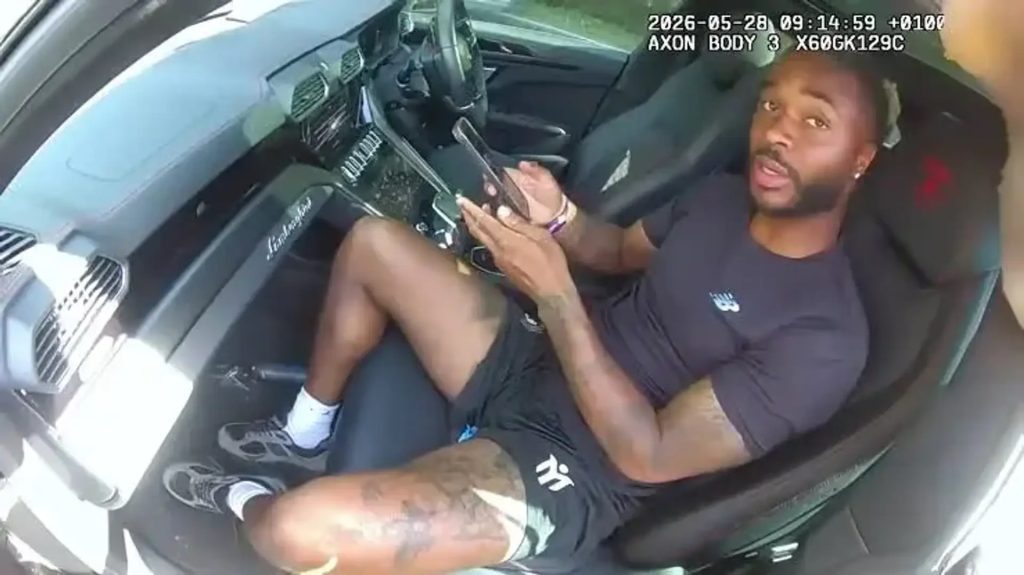
He was granted unconditional bail and given an interim driving disqualification. The court ordered pre-sentence reports ahead of a further hearing on 25 November, when the magistrates will decide whether to sentence him themselves or send the case to the Crown Court. Dangerous driving carries a maximum prison sentence of two years.
The legal outcome will be decided later. The immediate impact was reputational. Footballers are regularly involved in minor driving controversies, speeding offences or expensive-car accidents. This was different. The combination of dangerous driving, nitrous oxide, a failure to provide a specimen and an early-morning motorway crash gave the case a far darker feel.
It also landed at a moment when Sterling had lost the protection that comes with being central to a successful team. At City, he was one of the faces of a dominant side. At England level, he had been a player supporters could see on the biggest stages. A courtroom appearance after a serious lapse in judgement can be absorbed differently when the player is still winning, scoring and playing every week.
Sterling was not. He was a free agent, with his last competitive club appearance already receding, and his future in elite football uncertain. The incident therefore did not interrupt a thriving career. It became part of the story of a player who had been drifting away from the game at the highest level for years.
The boy from Brent who outran the system
Sterling’s rise was extraordinary long before he reached Manchester City. Born in Jamaica in 1994 and raised in north-west London after moving to England as a child, he grew up in Brent, close enough to Wembley for the national stadium to feel like a constant presence. His route to the top was not polished or conventional. He played for Alpha & Omega, joined Queens Park Rangers’ academy, then moved to Liverpool as a teenager.
By the age of 15, he was already a figure of national fascination. Liverpool had paid a compensation fee reported to be around £500,000 for him, an unusually large sum for a player who had not yet made a senior appearance. The fee reflected both his speed and his unusual ability to carry the ball at defenders without looking rushed.
He made his Liverpool debut in March 2012, aged 17 years and 107 days, becoming one of the club’s youngest-ever first-team players. At that point, the excitement was partly about rawness. Sterling was not yet a finished winger. He would overrun the ball, choose the wrong final pass and struggle in front of goal. But he frightened defenders in a way few teenage players can.
The essential attributes were obvious:
- Explosive acceleration over five to 10 metres.
- The ability to receive the ball in tight spaces and immediately turn.
- Courage to attack defenders repeatedly after losing possession.
- A low centre of gravity that made him difficult to knock off balance.
- Tactical flexibility across the front line.
By the 2013/14 season, he had become one of the decisive players in Liverpool’s title challenge under Brendan Rodgers. Luis Suarez and Daniel Sturridge scored more goals, but Sterling gave the side something different: movement from midfield into attack, the capacity to stretch a defence and the willingness to press from the front.
Liverpool narrowly missed the Premier League title. Sterling, still only 19, had become a full England international and one of the most valuable young attackers in Europe. The question was no longer whether he would become elite. It was which club would get the best years of him.
The Liverpool exit that shaped his reputation
Sterling’s 2015 move from Liverpool to Manchester City was one of the defining transfer sagas of that period. He had two years left on his Anfield deal, but contract talks had become tense. A televised interview with the BBC, conducted without Liverpool’s approval, created an impression of a player and entourage eager to force an exit. The reaction was intense. Sterling was 20, but he was discussed as though he were a veteran mercenary betraying a club.
City eventually paid £44 million, with the deal potentially rising to £49 million. At the time, that made Sterling the most expensive English footballer in history. The price amplified scrutiny around him.
The move also became a reference point for the way Sterling was treated in public. He was criticised for leaving Liverpool, criticised for his perceived ambition and frequently judged for things that attracted less attention when done by other young players. His clothing, cars, tattoos, house purchases and holiday photographs could become national stories.
Sterling later became more outspoken about the treatment of young Black footballers in the media. He questioned why certain players were portrayed differently from their white counterparts and became one of the sport’s strongest voices on the subject. He was not simply an elite footballer who happened to be Black; he was increasingly willing to discuss how race shaped football coverage and public assumptions.
That mattered because Sterling’s footballing career was never separate from his public image. He spent much of his peak managing a level of scrutiny that many of his contemporaries did not face.
Manchester City: the years that should have lasted longer
Sterling’s seven seasons at City were the best years of his career. They were also much better than the public memory sometimes allows. When he joined in 2015, City were still a leading club rather than the relentlessly dominant machine they became under Pep Guardiola. Sterling’s first season was uneven. Manuel Pellegrini used him in different positions, City finished fourth in the Premier League and he missed a penalty in the Champions League semi-final shoot-out against Real Madrid.
But Guardiola’s arrival in 2016 changed Sterling’s game. The new manager saw a winger whose speed was obvious but whose timing in the penalty area could be transformed. Guardiola worked on Sterling’s movement at the far post, his runs behind full-backs and his ability to arrive in scoring positions rather than merely create chaos from wide areas.
The results were dramatic. Sterling became the player who repeatedly appeared at the back post to finish low crosses. He developed an instinct for delayed runs, arriving after the defender had turned towards the ball. He became capable of playing on either wing, as a narrow forward or in a front two. He was not the most elegant finisher in the Premier League, but he reached chances in such volume that his numbers surged.
Across all competitions, Sterling left City with 131 goals and 74 assists in 339 appearances. He won four Premier League titles, five League Cups and an FA Cup. City collected 12 major trophies during his seven years at the club.
Sterling’s greatest individual league season came in 2018/19. Manchester City won the Premier League with 98 points, beating Liverpool by a single point in a title race that demanded near-perfection. Sterling scored 17 league goals and added 10 assists. He was named the Football Writers’ Association Footballer of the Year and PFA Young Player of the Year.
It was the season in which he stopped being described simply as a fast winger with potential. He was a match-winner. City’s football had many stars: Kevin De Bruyne’s passing, David Silva’s control, Sergio Aguero’s finishing, Bernardo Silva’s intelligence, Ederson’s distribution and Vincent Kompany’s leadership. But Sterling provided an essential element. He was often the runner who converted City’s territorial dominance into goals.
His late winners became a feature of the Guardiola era. The most famous was the 96th-minute goal against Southampton in the 2017/18 season, a strike that helped preserve City’s extraordinary unbeaten start. There were many others: back-post tap-ins, diagonal runs, cut-backs finished with one touch, scruffy goals created by the relentlessness of his movement. Sterling did not simply benefit from Guardiola’s system. He learned how to be decisive inside it.
A player more complete than his critics admitted
Even at his peak, Sterling could divide opinion. Supporters saw a forward who repeatedly reached scoring positions, gave defences problems and produced in major matches. Critics focused on missed chances, occasional poor decisions and a finishing technique that could look rushed.
Both impressions contained some truth. Sterling was never a natural striker in the manner of Aguero or Harry Kane. He could be erratic when a chance gave him too much time to think. He did not always strike the ball cleanly.
But this sometimes obscured the more important point: great attackers are not judged only by conversion. They are judged by the quantity and quality of situations they create or reach. Sterling’s movement meant he was constantly on the end of City attacks. His numbers were not an accident. They were the product of intelligence, pace and repetition. At City, he became one of the best off-ball forwards in Europe.
Sterling’s importance to England also rose sharply during the City years. He made his international debut in 2012, before he had even established himself as a Premier League regular. He would go on to win 82 caps between 2012 and 2022, appearing at three World Cups and two European Championships.
For a long time, his England career carried a strange contradiction. He was regularly criticised after ordinary club performances, but in major tournaments he often became England’s most dangerous attacker.
At the 2018 World Cup in Russia, Sterling’s movement created space for Harry Kane and helped England reach the semi-finals. He did not score, which allowed critics to focus on his finishing, but Gareth Southgate trusted him because he understood what Sterling provided without the ball.
At Euro 2020, played in 2021 because of the pandemic, Sterling was England’s standout player in the group stage. He scored the only goal in the 1–0 wins over Croatia and the Czech Republic, then scored again in the 2–0 last-16 victory over Germany at Wembley.
That goal against Germany carried particular significance. It was England’s first knockout victory over Germany since the 1966 World Cup final, and Sterling had become the player delivering in the moments English football traditionally feared.
He also won the penalty against Denmark in the semi-final, leading to Kane’s decisive rebound goal. England reached the final, where they lost to Italy on penalties. Sterling did not leave Euro 2020 with a trophy, but he left with a stronger claim to be England’s most important tournament attacker of the Southgate era.
The public figure — and the Manchester City exit
Sterling’s England role also extended beyond results. After suffering racist abuse in Montenegro in 2019, he spoke about the responsibility of football and media coverage. During the Black Lives Matter protests in 2020, he was again one of the game’s clearest voices, arguing that English football needed to confront racism rather than merely condemn individual incidents.
His willingness to speak made him unusually significant. Plenty of players posted statements or wore campaign shirts. Sterling gave interviews, challenged structural double standards and took reputational risks. That was part of why he became such a prominent figure during the peak of his career.
His later decline therefore feels sadder than a normal loss of form. This was not only a winger slowing down. It was a footballer who had occupied a genuinely important space in English sport.
By the summer of 2022, Sterling was still only 27. He had scored 13 Premier League goals in the previous season and remained a regular contributor. But the balance at Manchester City had changed.
Erling Haaland was arriving. Julian Alvarez had been signed. Phil Foden was becoming increasingly central, Jack Grealish had cost £100 million and City had other wide options. Sterling’s contract had two years remaining, but his minutes and his role no longer felt secure.
Guardiola’s City could be ruthless in a particular way. The club did not wait for a player to become obviously finished. If the squad could be upgraded or refreshed, it often moved early. Sterling was still useful, still productive and still capable of winning matches. But City no longer seemed prepared to guarantee him the status he wanted.
Chelsea: the move that broke the rhythm
Chelsea paid £47.5 million to sign Sterling. It was a logical move on paper. The Blues needed goals, experience and pace. Sterling wanted to become the focal point of an attack again. Thomas Tuchel was still Chelsea manager when the transfer was completed, and the expectation was that Sterling would be trusted as one of the club’s senior attacking figures. Within weeks, Tuchel was gone. That early managerial change became a symbol of everything that followed.
Sterling’s Chelsea career should be seen in the context of the club he joined. Chelsea in 2022 were not a settled elite side adding one high-class forward. They were beginning a period of constant managerial change, aggressive recruitment and unclear planning under new ownership. Tuchel was dismissed in September, Graham Potter replaced him, Potter was dismissed in April, and Frank Lampard returned as caretaker manager.
Sterling had moved from perhaps the most coherent football project in Europe to one of the most unstable dressing rooms in the Premier League.
The tactical consequences were obvious. At City, Sterling played within a system that created repeatable patterns. He knew where the cut-backs would arrive. He knew which midfielder would occupy which zone. He knew that City would dominate the ball, pin full-backs deep and force opponents to defend their penalty area for long spells.
Chelsea offered none of that certainty. The side changed shape, personnel and emphasis constantly. Attacks became disconnected. The forwards were often isolated. Sterling was sometimes asked to carry the ball long distances, sometimes play as a winger, sometimes play closer to the striker and sometimes work in a front line that changed every few games.
He still had moments. There were flashes of the old Sterling: a burst past a defender, a sharp movement in behind, a finish from close range. But he no longer looked like a player who knew exactly where the next chance would come from.
The numbers began to tell the story
Sterling’s Chelsea totals were not disastrous in isolation. He scored 19 goals in 81 appearances across all competitions. But the context was unforgiving. Chelsea had paid nearly £50 million for a player who was expected to provide elite-level reliability. Instead, he became one more forward in a group full of expensive attackers who never formed a convincing unit.
In the 2022/23 season, Chelsea finished 12th in the Premier League. Sterling scored six league goals. The following campaign was somewhat better for him individually, but not enough to restore the old status. Chelsea’s squad kept growing, competition increased and the club’s recruitment strategy repeatedly changed the hierarchy around him.
The biggest issue was not simply output. It was identity. At City, Sterling had a clear function. At Chelsea, he became a player who could be used in several ways but did not feel essential in any of them.
In August 2024, Sterling joined Arsenal on a season-long loan. It was supposed to be a smart rescue move. Arsenal were challenging at the top of the Premier League, Mikel Arteta knew Sterling from Manchester City, and the squad needed depth across the forward line. For Sterling, it offered the chance to return to a more structured environment under a manager familiar with his strengths.
Instead, the move exposed how far he had fallen. Sterling made 17 Premier League appearances for Arsenal, but only seven were starts. Across all competitions, he completed just three 90-minute matches.
He did not score in the league. The lack of minutes was damaging, but the lack of a defining performance was worse. Sterling did not force Arteta into a difficult selection decision. He did not become the trusted rotation option supporters expected. He did not even have the kind of short cup run that might have revived a narrative around him.
He looked like a player caught between two versions of himself. The old Sterling relied on pace, aggression and repeated runs behind a defence. Arsenal needed that at times, but their attacking structure was already built around Bukayo Saka, Gabriel Martinelli, Kai Havertz and other options. Sterling had not arrived as the centrepiece. He arrived as an experienced solution. When the solution did not immediately work, the minutes disappeared.
A loan to Arsenal could have been the perfect bridge back to relevance. Instead, it became evidence that the problem was no longer only Chelsea. Chelsea’s chaos could explain a decline in form. Arsenal’s stability made it harder to use the same explanation.
Sterling still had pedigree. He still had experience. He was still only 29 during the loan. But he could no longer turn occasional starts into the sustained influence that had defined his Manchester City years. By the end of the season, he was returning to Chelsea with less leverage than before.
Chelsea’s exile and the lost years
Sterling’s return to Chelsea in 2025 was the most humiliating phase of the decline. Rather than reintegrate him into the first-team group, Chelsea excluded him from the senior picture. He trained separately after being placed in what was widely described as the club’s ‘bomb squad’.
The phrase is ugly, but it captured the reality. Sterling was not injured. He was not retiring. He was not a youth prospect being developed patiently. He was a decorated England international, once worth £47.5 million to Chelsea, being removed from the main football operation while the club tried to reshape its wage bill and squad.